

When you compare a red light therapy mask, an RF skin tightening device, and a microcurrent facial device, the most useful question is not simply, “Which one is best?”
It is: “Which skin layer and biological process am I trying to influence?”
These three technologies occupy different positions in a beauty tech stack. A 660 nm/850 nm LED light therapy mask uses photons to support cellular activity from the epidermis into the dermis. An RF skin tightening device uses controlled radiofrequency heat to influence dermal and subdermal collagen at approximately 1–4 mm. A microcurrent facial device delivers low-level electrical current intended to stimulate facial muscles and surrounding tissue, commonly discussed in the approximately 5–7 mm muscular plane.
The depth numbers are useful for comparison, but they should not be treated as rigid anatomical boundaries. Facial thickness varies by location, age, tissue composition, and device design, while electrical current disperses rather than traveling in a perfectly straight line.
At a Glance: How the Three Devices Compare
| Device | Primary energy | Typical specification | Approximate target depth | Main skin layer or tissue target | Best suited to |
|---|---|---|---|---|---|
| Red light therapy mask | Red and near-infrared light | 660 nm + 850 nm; commonly measured in mW/cm² and J/cm² | Epidermal to dermal; 850 nm reaches deeper than 660 nm | Cellular activity, fibroblasts, collagen-supporting dermal tissue | Fine lines, tone, texture, visible radiance |
| RF skin tightening device | Radiofrequency energy | Commonly around 0.5–1.5 MHz, with approximately 1 MHz widely used in home devices | Approximately 1–4 mm | Dermal and subdermal collagen-rich tissue | Firmness, laxity, wrinkle appearance |
| Microcurrent facial device | Low-level electrical current | Often approximately 100–700 μA; frequency is device-specific | Approximately 5–7 mm as a muscular-plane comparison | Facial muscles and superficial connective tissue | Temporary lift, contour, toning, depuffing |
The simplest ranking by target depth is microcurrent first, RF second, and LED third. The most effective choice, however, depends on whether you want cellular support, collagen remodeling, or an immediate contouring effect.
1. Red Light Therapy Mask: Epidermal-to-Dermal Photobiomodulation
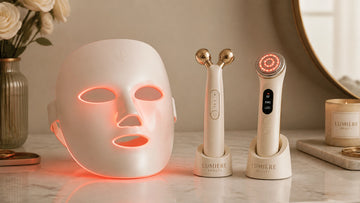
A red light therapy mask, also called an LED face mask or LED light therapy mask, delivers non-thermal light to the skin. The most relevant wavelengths for rejuvenation are generally in the red and near-infrared ranges, including 660 nm and 850 nm.
Unlike RF, LED treatment does not rely on heating collagen. Instead, photons interact with cellular chromophores, including mitochondrial cytochrome c oxidase, to influence ATP production, nitric oxide signaling, and cellular repair activity.
How 660 nm and 850 nm differ
At approximately 660 nm, red light primarily supports the epidermis and superficial-to-mid dermis. This is the region associated with visible texture, fine lines, uneven tone, and fibroblast activity involved in collagen and elastin production.
At approximately 850 nm, near-infrared light travels farther into tissue than visible red light. It is generally used to support deeper dermal processes associated with firmness, inflammation modulation, and overall skin resilience.
The result is not an instant mechanical lift. Instead, consistent photobiomodulation may support gradual improvements in the appearance of fine lines, elasticity, texture, and radiance over several weeks.
What the evidence suggests
Clinical LED studies have used red wavelengths around 630–660 nm and near-infrared wavelengths around 810–850 nm. In controlled facial rejuvenation studies, participants have reported measurable improvements in wrinkle appearance, skin elasticity, collagen density, and overall complexion, although outcomes vary according to irradiance, treatment dose, session frequency, and device fit.
Dose matters as much as wavelength. A device should ideally disclose irradiance in mW/cm² and energy dose in J/cm², because a mask emitting 660 nm light at an inadequate power density may not deliver the same practical result as a well-calibrated device.
For a deeper technical overview, read TheAurelia’s guide to LED light therapy mask wavelengths.
2. RF Skin Tightening Device: Controlled Heating at 1–4 mm
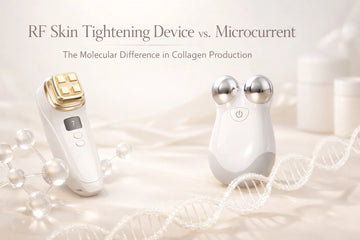
An RF skin tightening device works through radiofrequency energy rather than light. Its electrodes create an alternating electrical field that generates heat within the dermis and, depending on configuration, the superficial subdermal tissue.
Home bipolar and multipolar RF devices are commonly positioned in the approximately 1–4 mm range. Many systems operate near 1 MHz, although exact frequency, electrode geometry, power output, contact quality, and thermal controls vary between devices.
Why RF targets the dermis
The dermis contains collagen and elastin fibers that contribute to firmness and structural support. When RF creates controlled heating in this collagen-rich zone, existing collagen fibers may contract temporarily while heat-sensitive signaling pathways encourage longer-term remodeling.
Many home protocols aim for a warm but comfortable treatment sensation rather than aggressive heat. Some professional and home-use research discusses tissue temperatures in the low 40°C range, but you should always follow the temperature, movement, and session-time instructions provided for your specific device.
RF is therefore best understood as a dermal remodeling technology. It is not designed primarily to exfoliate the epidermis or stimulate facial muscles; its central purpose is to deliver controlled thermal energy to collagen-supporting tissue.
What results can you expect?
RF results are gradual because new collagen formation and reorganization take time. You may notice temporary plumping or improved circulation after a session, while visible changes in firmness and wrinkle appearance typically develop over approximately 4–12 weeks of consistent use.
A 2022 split-face study of a home RF device reported improvements in measures including wrinkles, radiance, skin color, and skin thickness after a 12-week protocol. Broader reviews of facial RF treatments also report improvements in firmness and texture, although studies combine different device types and treatment settings.
Explore TheAurelia’s RF and microcurrent comparison for a practical look at treatment goals and timelines.
3. Microcurrent Facial Device: The Muscular Plane at Approximately 5–7 mm
A microcurrent facial device delivers very low electrical currents through conductive gel or serum. Consumer devices commonly specify current intensity in microamps, often around 100–700 μA, rather than describing their energy in watts or joules.
For this beauty tech comparison, microcurrent is categorized as the deepest-reaching option, with an approximate target plane of 5–7 mm corresponding to facial muscle and nearby connective tissue. The exact depth is not fixed because current follows pathways determined by electrode placement, tissue conductivity, facial anatomy, and contact with the skin.
How microcurrent creates a visible lift
Microcurrent is intended to influence facial muscles and cellular electrical activity without generating the pronounced thermal response associated with RF. The sensation may feel like a mild tingle, and some users notice a temporarily more lifted, defined, or refreshed appearance after treatment.
The immediate effect is one of microcurrent’s main advantages. It can be appealing before an event or whenever you want a short-term contouring and depuffing effect without waiting for collagen remodeling.
The tradeoff is maintenance. Current research and expert assessments do not establish that consumer microcurrent creates the same lasting structural collagen remodeling associated with professional thermal or invasive procedures. Its visible benefits are generally considered temporary or maintenance-dependent, so regular use is important.
Treatment Depth Is Not the Same as Treatment Strength
A deeper target does not automatically mean a stronger or more effective treatment. Each technology delivers a different type of stimulus, and the tissue response depends on dose, duration, energy distribution, device design, and consistency.
A 660 nm LED light therapy mask may work more superficially than RF, but photobiomodulation can influence cellular signaling across the epidermis and dermis without intentionally heating the skin. RF works deeper through thermal stimulation, while microcurrent works through low-level electrical signaling directed toward facial muscles and surrounding tissue.
This is why comparing these devices by depth alone can be misleading. You should also compare the mechanism, treatment frequency, evidence, sensation, and the type of result you want to maintain.
Which Beauty Device Fits Your Goal?
Choose a red light therapy mask if you want:
- Gradual improvement in the appearance of fine lines and texture.
- Support for elasticity, tone, and visible radiance.
- A non-heating treatment that fits easily into a relaxing routine.
- Red and near-infrared photobiomodulation at clearly stated wavelengths.
- A device that can complement a broader anti-aging skincare plan.
Look for clearly disclosed wavelengths, irradiance, energy dose, eye protection, and realistic treatment guidance. A quality 660 nm/850 nm combination provides both visible red and near-infrared coverage.
Choose an RF skin tightening device if you want:
- A device focused on dermal collagen and skin firmness.
- Gradual improvement in the appearance of laxity and wrinkles.
- A warm facial massage sensation.
- A treatment that works at approximately 1–4 mm in the dermal and subdermal region.
- A structured routine with fewer sessions than daily microcurrent maintenance.
Keep the device moving as directed, use the recommended conductive medium if required, and never extend treatment time in an attempt to accelerate results.
Choose a microcurrent facial device if you want:
- A temporary lifted or more sculpted appearance.
- Facial muscle toning and contour-focused care.
- A quick treatment before an occasion.
- A non-thermal device with a gentle electrical sensation.
- A routine you can maintain several times per week.
Use conductive gel as directed and avoid microcurrent if you have an implanted electronic device or a condition for which electrical facial stimulation is contraindicated. When in doubt, consult a qualified healthcare professional before use.
Can You Combine LED, RF, and Microcurrent?
You can build a layered routine around different treatment days, provided each device’s instructions allow it and your skin tolerates the schedule. One practical approach is to use your red light therapy mask several times per week, reserve RF for its recommended treatment frequency, and use microcurrent on separate or alternating days.
Start with one device so you can understand how your skin responds. Once your routine feels comfortable, you can explore a complementary protocol rather than using every technology at maximum frequency from the beginning.
For more ideas, see TheAurelia’s guide to integrating a red light therapy mask, RF device, and microcurrent facial device.
The Bottom Line
By approximate treatment depth, the ranking is clear:
- Microcurrent facial device: muscular-plane stimulation at approximately 5–7 mm, with depth varying by anatomy and current path.
- RF skin tightening device: dermal and subdermal collagen heating at approximately 1–4 mm, commonly near 1 MHz in home-use designs.
- Red light therapy mask: epidermal-to-dermal photobiomodulation, with 660 nm red light supporting more superficial tissue and 850 nm near-infrared reaching deeper dermal layers.
The best device is the one that matches your primary goal and fits a routine you can maintain. Explore TheAurelia’s facial rejuvenation collection and anti-aging solutions to find a high-performance beauty tool that brings your preferred treatment layer into your everyday self-care ritual.


