

Achieving a flawless complexion and perfectly blended makeup is an art form, but even the most skilled artist requires the right lighting to master their craft. You have likely experienced the frustration of applying foundation that looks seamless in your bathroom, only to discover a visible jawline streak the moment you step into the sunlight. This common dilemma is rarely a reflection of your technique; rather, it is a result of the technical specifications of your light source.
To elevate your self-care ritual from a daily chore to a professional-grade experience, understanding the science behind your lighted vanity mirror is essential. Key metrics such as Color Rendering Index (CRI), lux levels, and color temperature play a pivotal role in how you perceive your skin’s texture and color. By optimizing these factors, you can ensure that your skincare assessments are accurate and your makeup application is nothing short of radiant.
Understanding the Color Rendering Index (CRI)
The Color Rendering Index, or CRI, is a quantitative measure of a light source's ability to reveal the colors of various objects faithfully in comparison with a natural light source. Measured on a scale from 0 to 100, a higher CRI indicates that the light is closer to natural daylight, which holds a perfect CRI of 100. For anyone serious about beauty, a mirror with a CRI of 90 or higher is the gold standard.
When you use a mirror with a low CRI, typically below 80, colors can appear dull, muddy, or shifted. This makes it incredibly difficult to distinguish between subtle undertones in your skin or to choose the correct shade of concealer. A high-CRI lighted vanity mirror ensures that the pigments in your products look exactly as they should, preventing the common mishap of over-applying blush or choosing a foundation that is too cool for your warm complexion.
The Significance of the R9 Value
While many brands advertise a high overall CRI, the R9 value is a specific technical detail that you should not overlook. CRI is an average of several test colors, but R9 specifically measures how well a light source renders saturated red tones. Because human skin tones are rich in red and pink pigments, a high R9 value is crucial for seeing the true health of your skin.
A mirror with a strong R9 rating allows you to accurately identify areas of inflammation, rosacea, or subtle blemishes that might be hidden under poor lighting. This precision is vital when you are tracking the progress of treatments like the Rechargeable LED Beauty Mask, where observing skin rejuvenation and reduced redness is key to your routine.

The Role of Lux in Illuminating Detail
While CRI handles the quality of color, lux measures the intensity of light: specifically, how much light is falling on your face. For detailed beauty tasks, the standard ambient lighting in a bathroom is often insufficient. Most residential bathrooms provide around 200 to 300 lux, which is suitable for general movement but falls short for precision work.
To achieve salon-quality results at home, you should aim for an illuminance level between 500 and 1000 lux at the surface of your skin. This level of brightness allows you to see fine lines, pores, and the exact edges of your eyeliner without causing eye strain. However, it is important that this light is diffused. A well-designed lighted vanity mirror uses edge-lighting and high-quality diffusers to ensure the light is even and soft, eliminating the harsh shadows that can lead to uneven makeup application.
Balancing Brightness for Skincare Accuracy
High lux levels are particularly beneficial when using high-performance tools like a Heating Pore Cleansing Blackhead Apparatus. When you are performing extractions or deep cleansing, you need to see every detail of your pores to ensure you are working safely and effectively. Proper illumination ensures that you do not miss any areas or apply too much pressure in places where the skin is particularly delicate.
Color Temperature: Finding the Sweet Spot
Color temperature is measured in Kelvins (K) and describes the visual warmth or coolness of the light. In the world of beauty, the three most common settings you will encounter are 3000K, 4000K, and 5000K. Each of these serves a specific purpose in your routine, and choosing a mirror with adjustable settings can transform your preparation process.
3000K: The Warm Glow
A temperature of 3000K provides a warm, yellowish light that mimics the atmosphere of a cozy restaurant or a sunset. While this setting is incredibly flattering and perfect for a relaxing evening skincare routine, it is not ideal for color matching. Warm light can mask redness and make cool-toned products appear more golden than they are. Use this setting when you want to feel pampered and relaxed, perhaps while using a Massage Comb with Magnetic Therapy to unwind after a long day.
4000K: The Neutral Choice
Often referred to as neutral or natural white, 4000K is widely considered the ideal balance for everyday grooming. It provides a crisp, clean light that does not lean too far into the yellow or blue spectrums. This setting is perfect for your morning routine, offering enough clarity for precision while remaining comfortable for the eyes. It mimics the light of a well-lit office or retail environment, ensuring you look great throughout your workday.
5000K: The Daylight Standard
For the most accurate color matching, 5000K is the professional choice. This temperature mimics bright midday sun and is the most unforgiving: and therefore the most helpful: setting for makeup application. If your foundation looks seamless at 5000K, it will look seamless anywhere. This is the setting you should use when applying bold eyeshadows or matching your foundation to your neck and chest.

Impact on Skincare Precision and Device Use
Your skincare routine is an investment in your future self, and the precision of that routine is directly tied to your visibility. High-performance skincare often involves devices that require a clear view of the face. For instance, when using an IPL Face Lifting and Skin Rejuvenation Device, you need to ensure that you are covering all areas of the skin evenly while avoiding any sensitive spots.
Proper lighting allows you to see the immediate effects of your treatments. Whether it is the subtle flush after a radiofrequency session or the improved texture after using an Electric Facial Cleansing Brush, a high-CRI mirror ensures you are seeing real results rather than lighting-induced illusions. This feedback loop is essential for staying motivated and consistent with your beauty technology.
Makeup Application: Mastering the Match
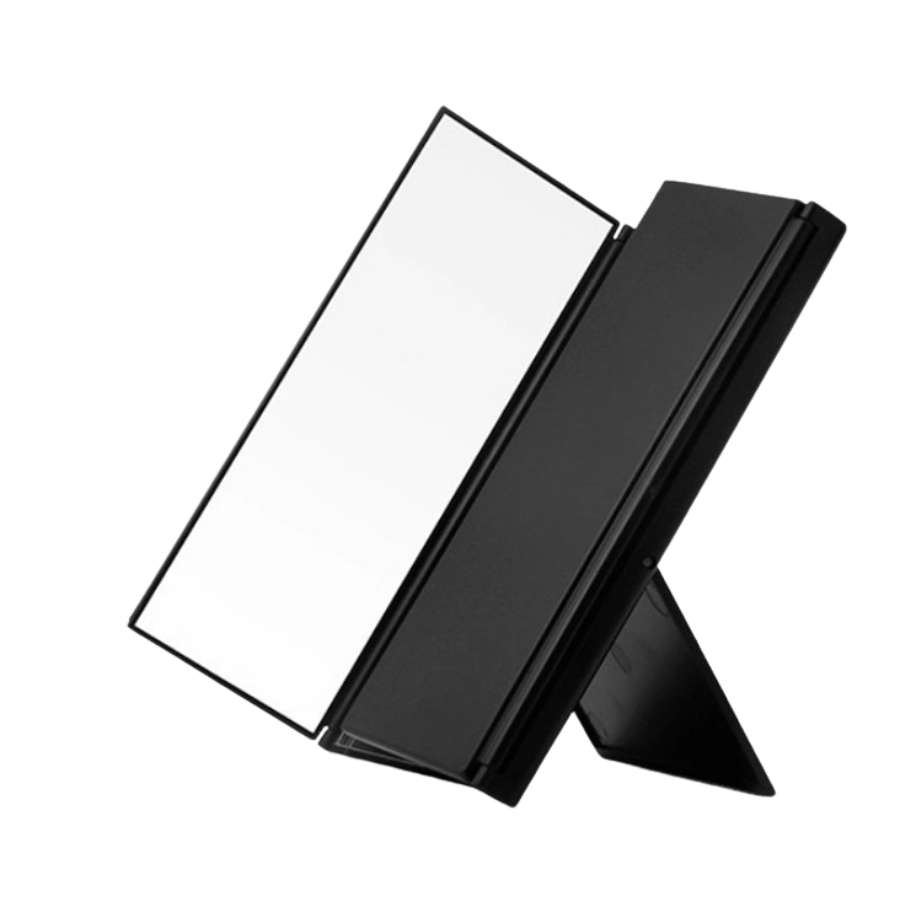
The ultimate test of any lighted vanity mirror is the final makeup look. To avoid the dreaded "cakey" appearance, you need lighting that reveals texture without washing you out. The LED Tri-Fold Mirror from TheAurelia is designed specifically for this level of detail. With its built-in LED illumination and multiple panels, you can view your face from different angles, ensuring that your contour is blended and your highlight is perfectly placed.
The tri-fold design is especially useful for checking the symmetry of your brows and eyeliner. By utilizing the side panels, you can see your profile and ensure that your makeup transition from the face to the jawline is invisible. This level of detail is simply impossible with a standard, flat bathroom mirror.
Choosing Your Perfect Lighted Vanity Mirror
When selecting the right mirror for your home, consider your specific needs and the environment of your vanity. Look for a device that offers:
- CRI of 90 or higher for true color representation.
- Adjustable brightness settings to reach at least 500 lux on your face.
- Multiple color temperature modes (3000K to 5000K) to suit different tasks.
- Portability and durability, especially if you travel frequently.
By prioritizing these technical features, you are not just buying a mirror; you are investing in a tool that enhances the efficacy of every other beauty product you own. Whether you are performing a deep-cleansing ritual or preparing for a high-profile event, the right light makes all the difference.

Illuminate Your Beauty Journey
At TheAurelia, we believe that professional results should be accessible in the comfort of your own home. Our collection of high-performance beauty tools and mirrors is curated to help you achieve your most radiant skin yet. By combining advanced technology with elegant design, we empower you to take control of your self-care routine with confidence and precision.
Explore our full range of beauty devices and mirrors today and discover how the right light can transform your perspective on beauty.


